How far should an embodied system change after unexpected experience? Research OS, Mismatch Lab, and Builder Lab by Seonhye Gu.
Evidence: EXP-SURG-001 proper program D0–D3 · Isaac Sim 4.1 · ORBIT IK-Rel
Regenerate:python scripts/plot_paper1_figures.py
Isaac capture:bash scripts/capture_study1_viewport.sh(GPU)
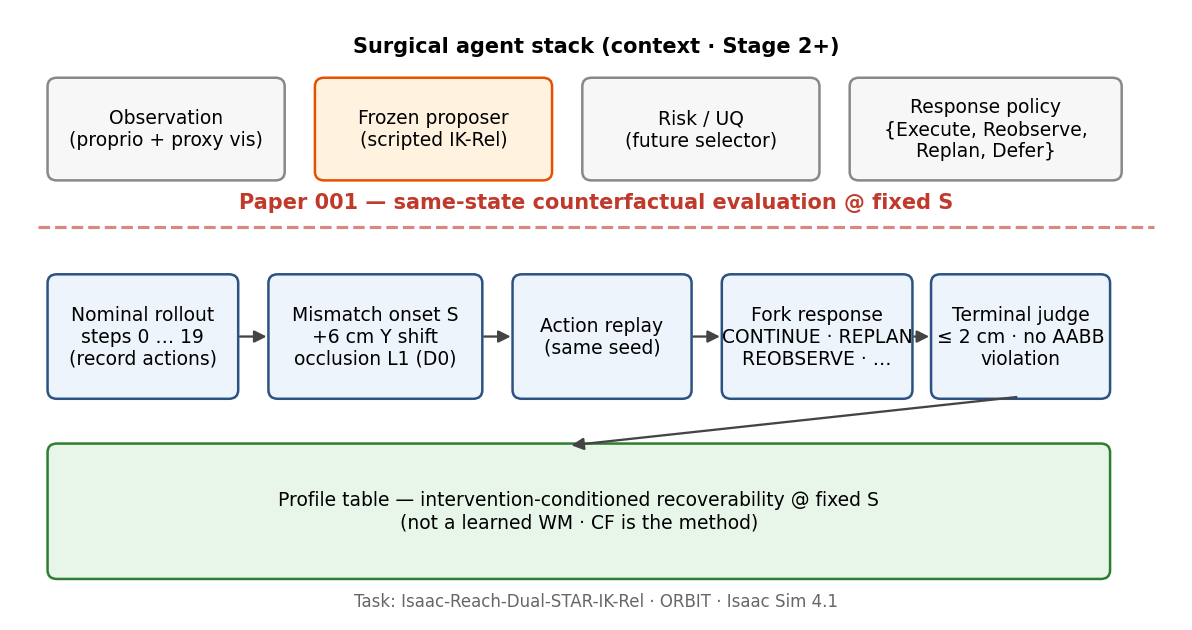
Figure 1. Paper 001 evaluation architecture. A frozen scripted proposer executes nominal reach until mismatch onset S (6 cm target shift + occlusion proxy L1 in D0). Recorded actions are replayed from the same seed so all branches share identical state through S; only the post-onset response differs. Terminal outcomes are judged by distance to the shifted target (≤ 2 cm), forbidden-zone violations, and step budget. The upper row situates the measurement within a broader surgical agent stack (Stage 2+); Paper 001 claims profile separation, not a learned selector.
PNG: fig1_architecture_overview.png
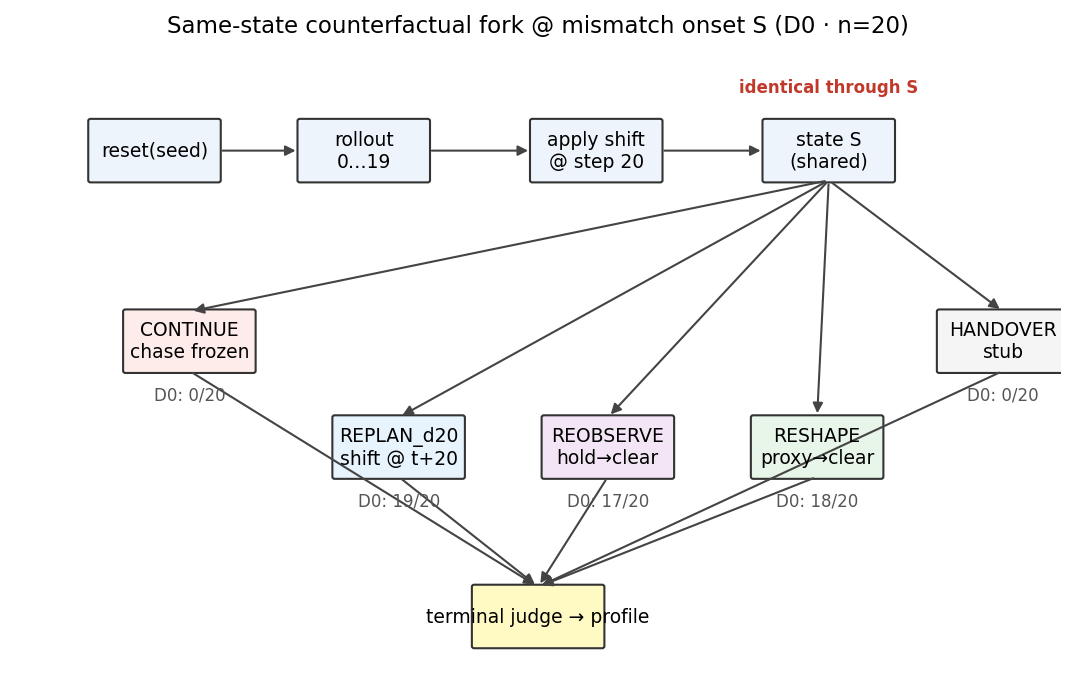
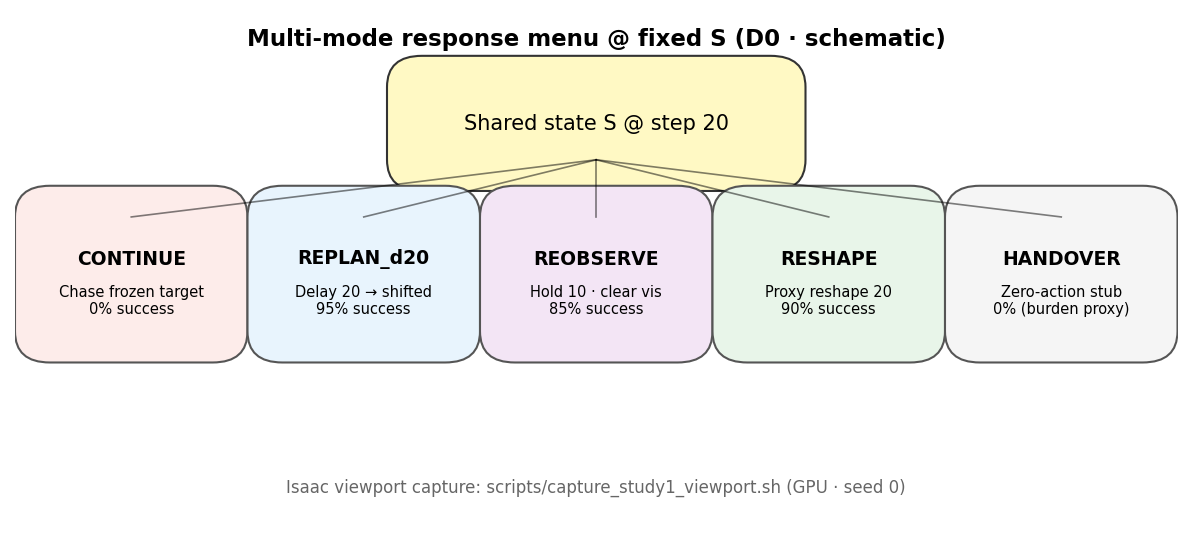
Figure 2. Same-state counterfactual fork at mismatch onset S (step 20). All branches replay identical pre-onset actions, apply the same target shift, then diverge by response mode. D0 confirmatory rates (n=20): REPLAN_d20 19/20, REOBSERVE 17/20, RESHAPE 18/20, CONTINUE 0/20, HANDOVER stub 0/20.
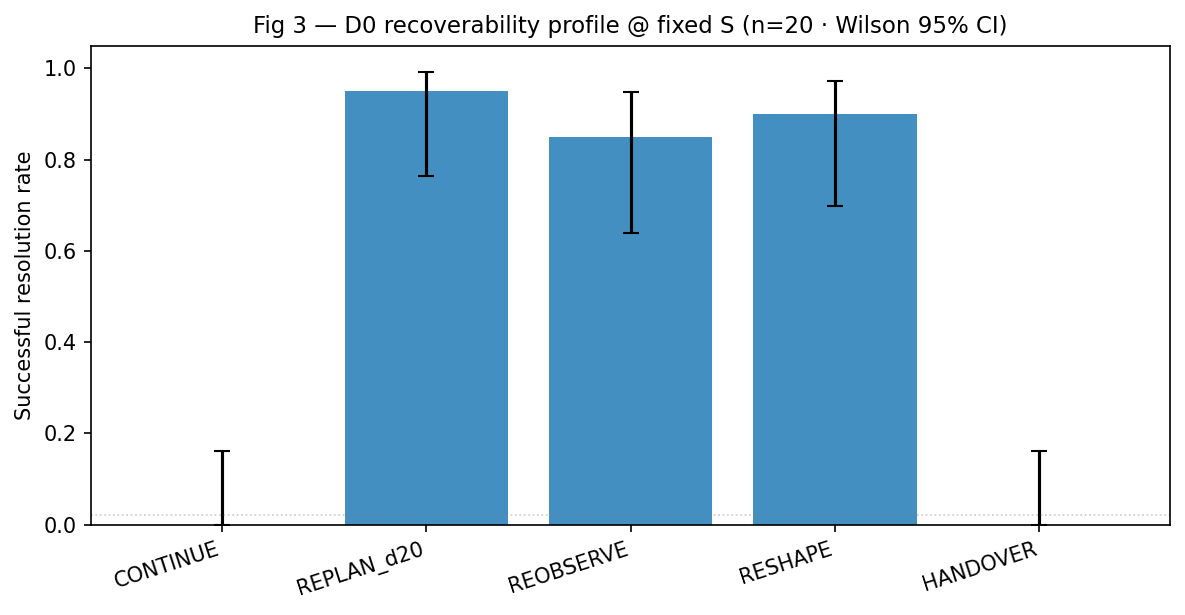
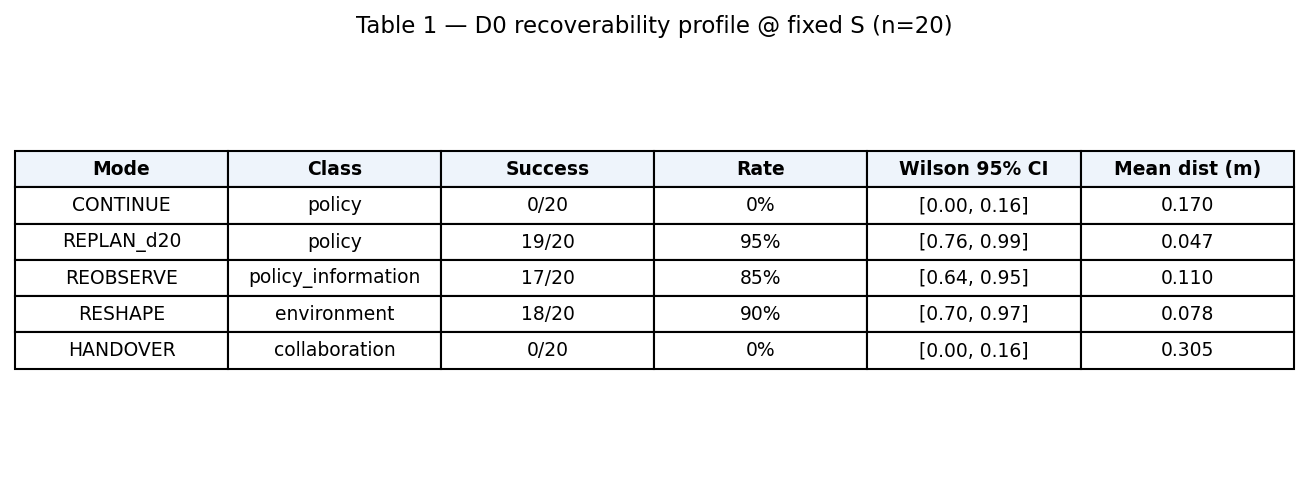
Figure 3. Intervention-conditioned recoverability profile at fixed mismatch onset S (6 cm Y shift + occlusion L1 · REPLAN delay 20 steps · n=20). Same-state counterfactual branches share replay through S; success = terminal distance to shifted target ≤ 2 cm without forbidden violation. Error bars: Wilson 95% CI. HANDOVER is a collaboration stub excluded from the primary endpoint.
PNG: fig3_profile_d0.png · Table: table1_d0_results.png
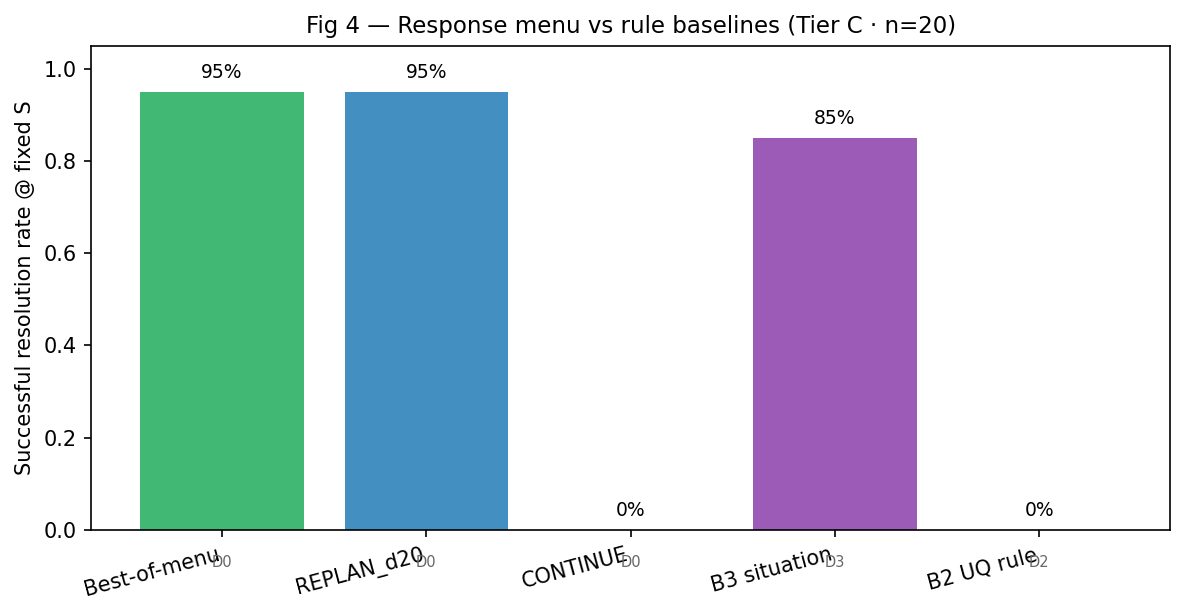
Figure 4. Response menu vs rule baselines at the same anchor S. Best-of-menu (max of REPLAN, REOBSERVE, RESHAPE) reaches 95%; REPLAN_d20 alone 95%; B3 situation rule (REOBSERVE path) 85%; B2 UQ-inspired binary rule triggers HANDOVER on all 20 seeds (0% success on primary metric). Pre-registered Option A direction met: menu best > B2 and > B3.
PNG: fig4_baseline_overlay.png
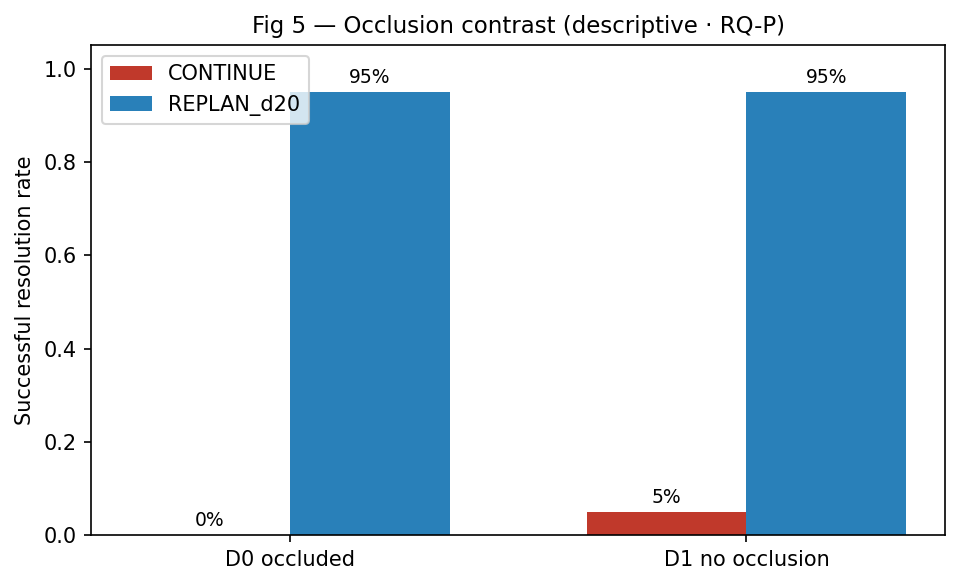
Figure 5. Descriptive occlusion contrast: D0 (occlusion L1) vs D1 (no occlusion) for CONTINUE and REPLAN_d20 @ fixed S. REPLAN remains 19/20 in both conditions; CONTINUE rises from 0/20 to 1/20 without occlusion. No superiority claim beyond pre-registered descriptive contrast.
PNG: fig5_occlusion_contrast.png
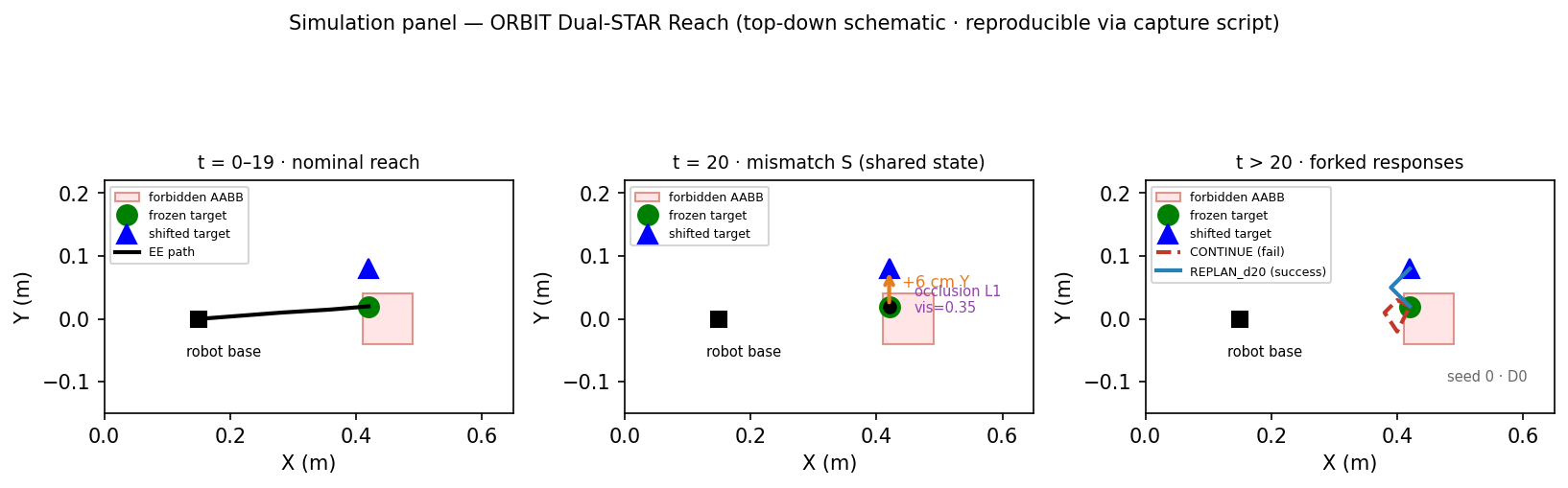
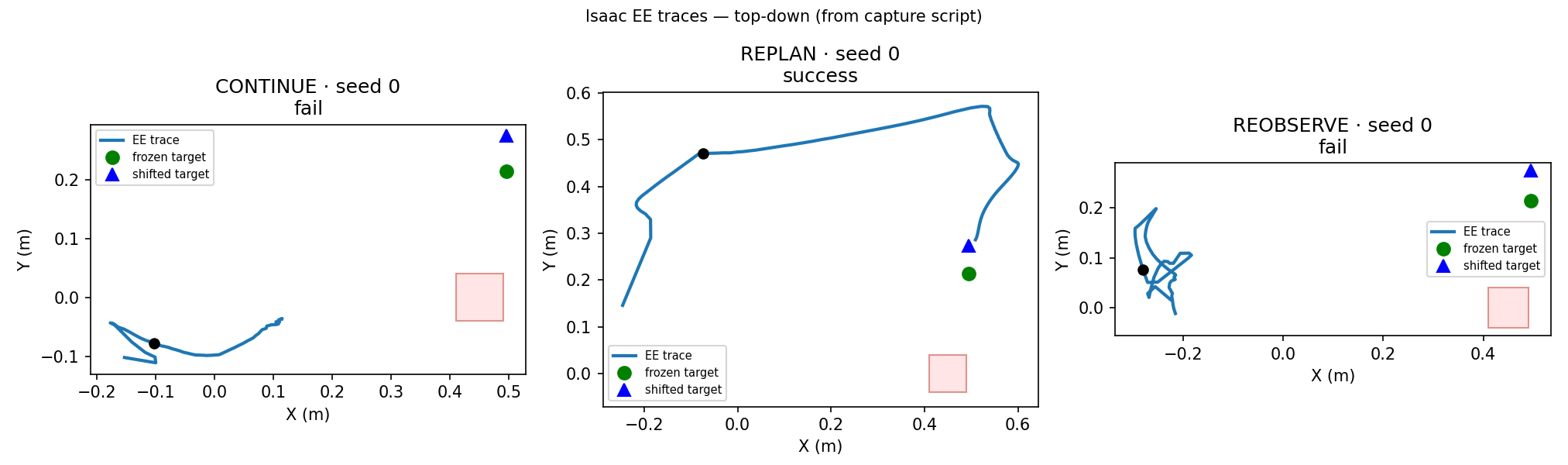
Simulation panel (schematic). Top-down ORBIT Dual-STAR Reach workspace showing frozen vs shifted targets, forbidden AABB proxy, and schematic EE divergence after S. Static PNG for paper; reproducible Isaac EE traces via
scripts/capture_study1_viewport.sh.
PNG: sim_panel_continue_replan.png · sim_panel_multimode.png
Isaac EE traces (Tier C · seed 0 · 2026-07-24): sim_panel_isaac_traces.png · traces in isaac_captures/
Smoke n=5 · 3 cm shift · CONTINUE 0/5 vs REPLAN 4/5. Superseded for claims by Fig 3 (Tier C).
Flat REPLAN band at P2@3 cm · RQ-T deferred from main text.
PNG: recoverability_vs_delay.png
Scripted proposer · single ORBIT reach task · occlusion gain-scale proxy v0.1.
Tier C: pre-reg v2.0 · n=20 per branch · branch_replay_ok on all records.